 Jaba Learning
How I Became a Data Analyst
October 25, 2026 · 4 min read
I didn't know there was a profession called data analyst until I applied and interviewed for my first job near the end of graduate school. My dream job had been one where I could sit in a room, preferably one with a window, and work on math proofs all day. The naivety of youth.
That first job was in the Research division of ETS (Educational Testing Service) in Princeton, New Jersey, and it felt a lot like a graduate department. Offices lined both sides of a hallway that ran the length of the building: managers and senior analysts in single offices on the left, junior analysts doubled up on the right. It was collaborative, egoless and nurturing. Senior analysts, some with more than 30 years at ETS, mentored us juniors in the esoteric methods of psychometrics, the science of educational measurement.
There wasn't much of a tech stack, at least nothing resembling a typical data analyst job posting. What I learned in my five years there was how to work collaboratively, pay attention to small details, and be accountable for my deliverables. I believe those soft skills matter as much as the tech stack alphabet soup, and they're probably harder to learn.
My second role was in the supply chain division of a legacy book publisher. They hired me as a data analyst but never gave me the title of Data Analyst. Frankly, I'm not sure the department head knew what a Data Analyst was, or what exactly they wanted me to do. My guess is the directive came from above: the world was moving toward digital content, and the division needed a data person among its project managers. My first title was Procurement Analyst, though I did no procurement.
My manager was a seasoned project manager with deep knowledge of book bindings, paper stock and glue specifications, but he knew little about using data to drive decisions. At the time it felt like an odd fit. In retrospect, it was perfect: I was free to build the role however I thought I could add the most value.
An adjacent department had just set up SQL Server and was importing all of the division's data. I connected with them, and within a few weeks I was teaching myself SQL, writing my own queries and producing reports. The better I got at SQL, the more requests poured in. For project managers who lived in Excel, I built Excel dashboards with live connections to SQL Server. A few wanted me to teach them SQL, but most just wanted to keep using the program they already knew.
That taught me the quickest way to add value as an analyst: get people what they want in the easiest way possible. I had to keep learning and honing my skills, but the people I served didn't care about my skill set. They just wanted results.
Over six years there, I made SQL my specialty. I picked up a little Python, VBA and Tableau along the way, but SQL filled the hole that math left when I finished graduate school. I enjoyed writing queries as much as I had enjoyed writing proofs. The underlying logic was the same.
After 22 years as a data analyst, I still enjoy writing SQL. I see the tables, joins, partitions, window functions and aggregations in my mind before I write the first SELECT. I love struggling with an analysis and then finding clarity after a break, the same way the path to proving a theorem would sometimes appear in the shower or on the bus to school.
Some students today go to school to become analysts. I fell into the role and learned along the way, picking up the skills I needed but always relying on the logical thinking at the heart of mathematics. And the collaborative work of analyzing data with colleagues turned out to be far more rewarding than that quiet room with a window I once imagined.
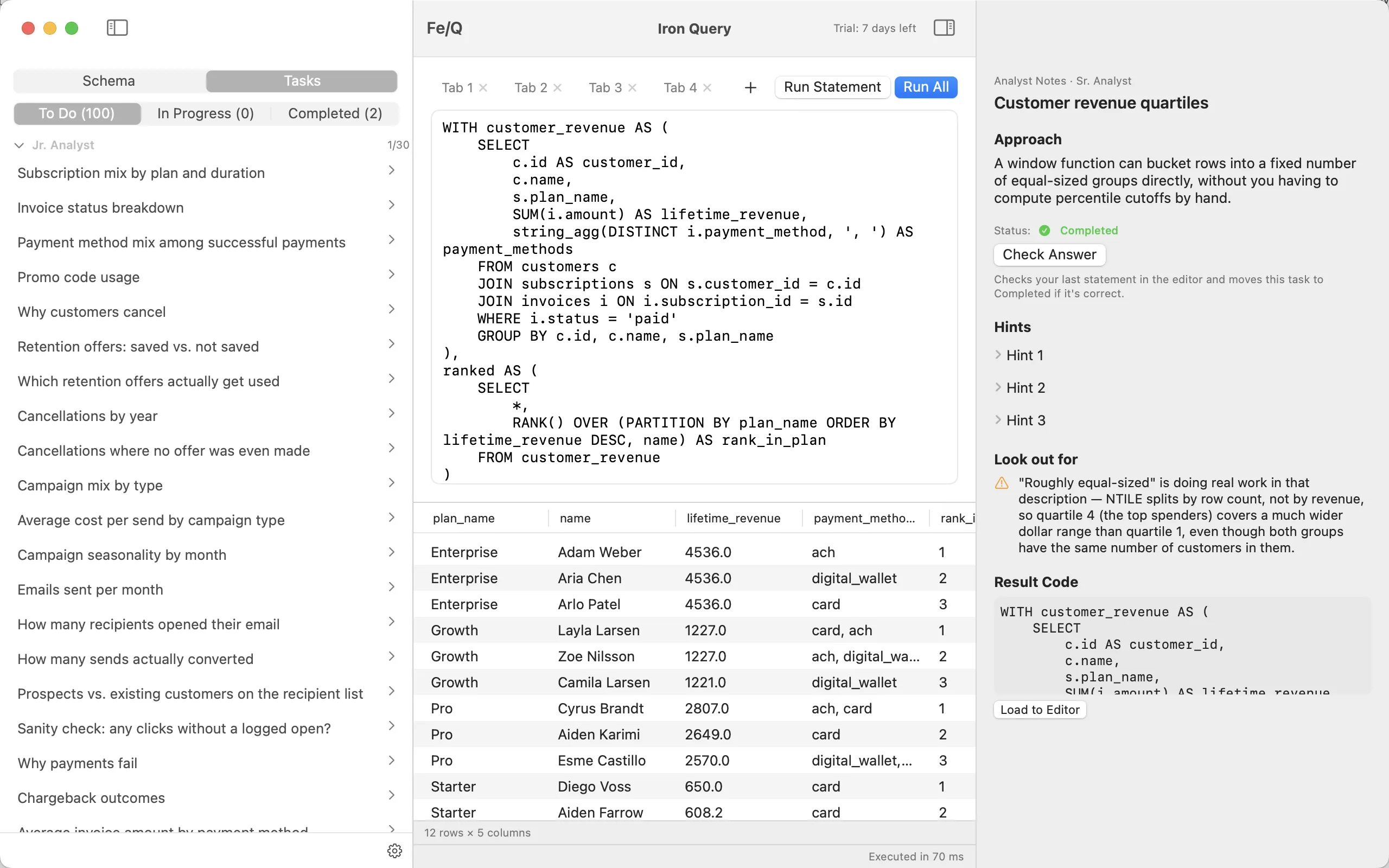
If you're taking your own first steps toward becoming a data analyst, I built Iron Query to teach SQL the way I learned it on the job: by answering real business questions.